Geological Landscapes Inject High-End DNA into Cultural Tourism
— An Analysis of the Geological Landscape Foundation for High-End Cultural Tourism Planning of the Taihang Sky Road in Taihang Grand Canyon
The Taihang Sky Road is a core scenic road within the Taihang Grand Canyon Scenic Area in Linzhou, Henan Province. It winds along the mountainside at an altitude of about 1,300 meters. With a length of 30 to 35 kilometers and 189 bends, the road spirals above countless ravines and valleys, providing a natural three-dimensional space for high-end cultural tourism planning in the scenic area.
The high-end cultural tourism upgrade of the Taihang Sky Road cannot be separated from its geological and cultural foundation. This foundation is by no means a simple borrowing of scenery; the key lies in transforming profound geological evolution history into a core attraction that can be experienced and narrated.
Clear Advantages of the Geological Foundation
The Taihang Sky Road is a key node along the geological structural profile of the Taihang Mountains. It is also a display corridor for the stepped terrain structure of the Taihang Mountains and the best viewing site for the geological relics and geological landscapes of the Grand Canyon. Deeply integrating it with geological culture and turning it into a walking geological classroom is of great practical significance for upgrading the quality of Grand Canyon tourism.
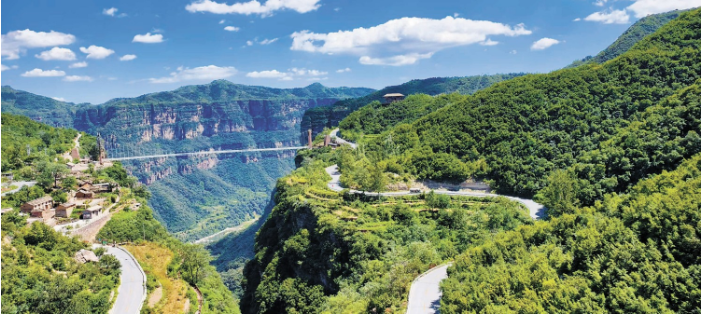
Taihang Sky Road in Taihang Grand Canyon
What types of geological landscape culture does the Taihang Sky Road contain?
It is a stage displaying the uplift and subsidence of the North China Plate. The Taihang Mountains are one of the most prominent geomorphic boundaries between plateau and plain in eastern China. Their magnificent cliffs and precipices are the direct result of strong differential uplift of the North China Plate since the Cenozoic. The deep abysses and flat-topped mountains along the Sky Road are on-site evidence of differential crustal uplift. To the east of the Taihang Mountains lies the vast North China subsidence plain, while to the west lies the Loess Plateau; to the east of the Linlü Mountains lies the Linzhou faulted basin, while to the west lies the Taihang Grand Canyon; west of the Taihang Grand Canyon is the main range of the Taihang Mountains. The Taihang Sky Road is like standing on the shoulder of uplift. From the Sky Road, visitors can directly perceive and understand the region’s large-scale geological framework and geological origins.
It is a layered history book from ocean to land. On the steep rock walls on both sides of the Taihang Grand Canyon, clear horizontal bedding, red quartz sandstone, oolitic limestone, bamboo-leaf-like limestone, or tempestite, ripple marks, mud cracks, trace-fossil limestone, stromatolites, trilobite fossils and other geological relics and phenomena can be observed. These are silent testimonies left by this land during two warm shallow-sea periods billions and hundreds of millions of years ago. They provide a physical basis for planning a storyline of an ocean corridor that travels through one billion years of time and space, from 1.4 to 1.0 billion years ago and from 540 to 460 million years ago. On the top of the Taihang Mountains and in the Shanxi Plateau area, Carboniferous–Permian marine-terrestrial transitional deposits and Mesozoic continental deposits are distributed, including sandstone, mudstone, coal seams, and various typical plant fossils. They record the environmental characteristics of rivers, lakes, organisms, and landscapes after frequent sea-land changes and marine retreat. This section, which records a complete sequence of sea-land transformation and life evolution, is an even grander creation story.
It is a living textbook of geological relics and landscapes. The canyon wonders, unusual peaks and rocks, rock formation profiles, and typical geological relic phenomena along the Taihang Sky Road directly reveal the magnificent chapters of Earth’s evolution. The sedimentary rock layers exposed on the steep cliffs on both sides of the canyon record the transformation from ancient ocean to land. About one billion years ago, during the Mesoproterozoic, this area was a shallow-sea environment on the North China Platform. Quartz sandstone and shale were deposited and consolidated on the seabed, forming the basic framework of the Taihang Mountains. Later, tectonic uplift and fluvial erosion shaped the deep canyons and peak-cluster landforms. When visitors stop at viewing platforms, they can directly observe features such as inclined rock layers and developed joints, as if turning the pages of an Earth chronicle.
Taking Geological Phenomena as the Core Entry Point for Experience
The core of cultural tourism planning for the Sky Road is to transform hard-core geological science into a soft narrative experience.
Create a window for geological culture promotion. Key viewing platforms along the Sky Road can be developed into windows for geological culture promotion. At specific sites such as thick limestone sections, red sandstone sections, and fault contact zones, augmented reality observation devices and telescopes can be installed. When visitors scan the rock walls, AR screens can present real-time scenes of ancient marine life swimming or dynamic reconstructions of stratigraphic uplift and subsidence, including faulting and folding. Telescopes can allow visitors to observe the microscopic structural features of cliff rock layers in detail.
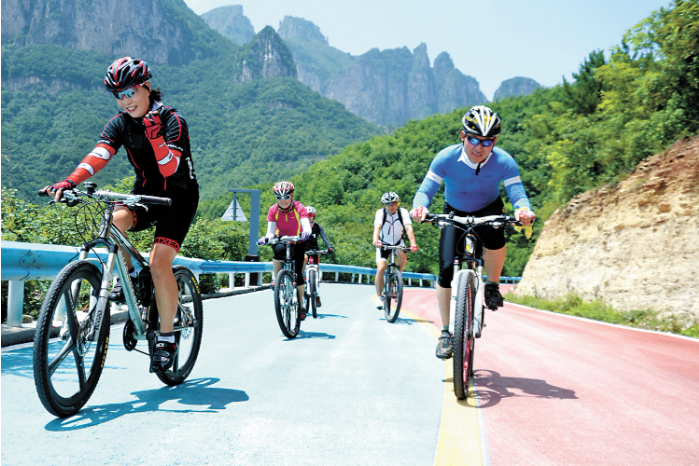
Cycling enthusiasts ride along the Taihang Sky Road
Create geological science popularization trails. The road itself can be transformed into a flowing exhibit. Spaces such as tunnel inner walls and slope-protection walls can be used to display geological phenomena, stratigraphic profile maps, geological time scales and other content through artistic projections under the theme of “Light of Geology,” turning the journey through the Sky Road by vehicle into an immersive science popularization experience through geological time. A segmented study-tour route can also be created. QR-code signs can be installed at key viewing platforms, allowing visitors to scan and listen to audio guides about geological ages, rock types, and tectonic processes. In safe areas, facilities such as rock-layer models and simulated geological hammering can be set up, enabling participants to understand sedimentary structures and metamorphism through touch and operation.
Design themed hiking routes. From the end of the Sky Road to the canyon floor, a geological exploration trail can be designed to guide visitors from the connecting trail of the Sky Road down into the canyon floor. By comparing lithological changes in the vertical section, visitors can intuitively experience the scale of crustal uplift. During the walk, the route can be designed around sensory experiences. Visually, visitors can be guided to compare landforms such as cuesta slopes and hogback ridges on both sides of the canyon. Audibly, the sounds of wind and streams can help visitors perceive exogenic geological processes. Tactilely, visitors can touch different rock layers to feel differences in hardness and texture. Ecological content can also be integrated, introducing how canyon vegetation adapts to rock-weathering environments, while folk culture can be incorporated to show how local stone-slab dwellings use local rocks.
Design narrative themed routes. With the Taihang Mountains’ spirit of “the backbone of China” as the positioning, a themed route called the “Road of the Backbone” can be created. By extracting the spiritual imagery of three major rock types—metamorphic rock representing the resilience of “transformation and rebirth through trials,” red quartz sandstone representing firmness and mountain radiance, and limestone representing inclusiveness through “dissolution by water and broad capacity”—geological tectonic movements such as uplift and faulting can be deeply integrated with the national spirit of perseverance and rise. At the same time, creative check-in spots can be added to present these ideas through concrete artistic expression and provide a richer range of tourism products.
Productization and integrated business formats. Along the Taihang Sky Road and its connecting routes at both ends, a scientific investigation route titled “I Am a Little Geologist” can be designed. Study-tour manuals can be prepared, and simple geological study toolkits can be provided so that young people can carry out activities such as measuring stratigraphic dip angles and rock-layer thickness, collecting rock samples, and searching for fossil traces in the field. At the same time, cultural and creative derivative products can be developed using aesthetic elements from the bedding, textures, ripple marks, and mud cracks of the rock layers in Taihang Grand Canyon, such as scarves with bedding patterns, stratigraphic-slice paperweights, and “ancient sea salt” flavored foods.
The Taihang Sky Road is not only a high-altitude scenic road, but also a walking geological classroom. Geological and cultural planning for it is a key step in promoting the high-quality development of Sky Road tourism. The key to successful planning lies in the unity of three dimensions. First is the accuracy of the scientific core: the narrative content and forms of expression at all nodes must be built on a solid geological scientific foundation. Second is the creativity of experience transformation: because geological science is characterized by “invisible forces,” cutting-edge technology and artistic methods are needed to transform invisible geological forces into perceptible concrete forms, thereby developing them into the foundation of local culture and allowing cold stones to tell stories. Third is the depth of spiritual resonance: the force and beauty of geology should be elevated into the soul and spirit of culture, allowing visitors to gain deep emotional impact and intellectual inspiration while marveling at the power of nature.
Only in this way can the Taihang Sky Road transform from a transportation project or scenic viewing facility into an immersive geological culture experience destination with international appeal, becoming a magnificent answer to the question of “Why Taihang?” (Zhang Zhonghui and Wang Tongwen)
Source: China Green Times