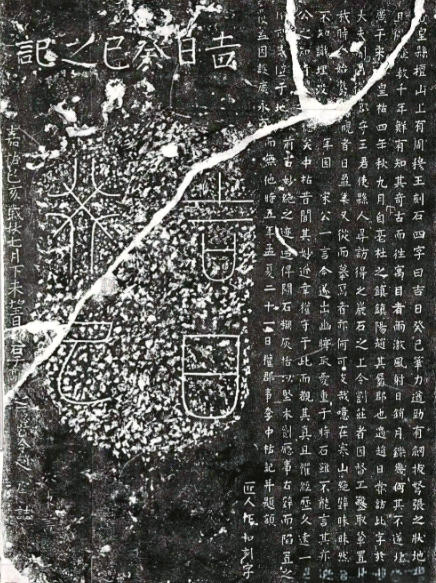
According to the Zanhuang County Annals, during the Western Zhou Dynasty, King Mu of Zhou, Ji Man, “arrived at Fangzi on the Guichou day and climbed Cuan Mountain.” Legend has it that when King Mu of Zhou was fighting against the Quanrong, the Quanrong army was stationed around the Zhangshiyan area, relying on the dangerous terrain for defense. King Mu could not conquer them for a long time, so he stationed his troops at Tanshan Mountain, northeast of Zanhuang County. It was the hottest period of summer, and he stayed there to escape the heat. On the day before “Guisi,” King Mu planned to launch an attack against the Quanrong. However, one of his advisers said that the following day, “Guisi,” was an inauspicious day and not suitable for military action. King Mu ignored the advice, rose angrily, drew his sword, and carved the four characters “Jiri Guisi” on the cliff wall, declaring loudly, “Guisi is auspicious, so why should it hinder military action?” He then led his troops forward and defeated the main force of the Quanrong in one decisive attack. Afterwards, he climbed Cuan Mountain and took in its scenery. Believing that his victory had benefited from the help of Cuan Mountain, he renamed it Zanhuang Mountain, and Zanhuang County thus got its name.
The four characters “Jiri Guisi” were originally carved on the cliff wall of Tanshan Mountain and are historically known as the Tan Mountain Stone Inscription. Works such as Ciyuan, Cihai, Hanyu Da Cidian, Jinshi Cuibian, and Guide to Antiques all include entries on the Tan Mountain Stone Inscription. Wang Anshi, a famous minister of the Song Dynasty, once wrote in a poem: “Who treasures the Tanshan inscription, appreciated together with the Lanting calligraphy copy.” This is enough to prove its far-reaching fame.
The four characters are written in a style similar to small seal script and bronze inscription script, making them a precious work of calligraphy. The original inscription was taken into the imperial collection during the Zhenghe period of the Song Dynasty. The existing stone inscription is a copy made by Li Zhongyou in the fifth year of the Huangyou period of the Song Dynasty. The whereabouts of the original stone are now unknown. This stone inscription is a national key cultural relic protection unit, regarded as the treasure of Zanhuang County and the treasured cultural relic of Zhangshiyan.