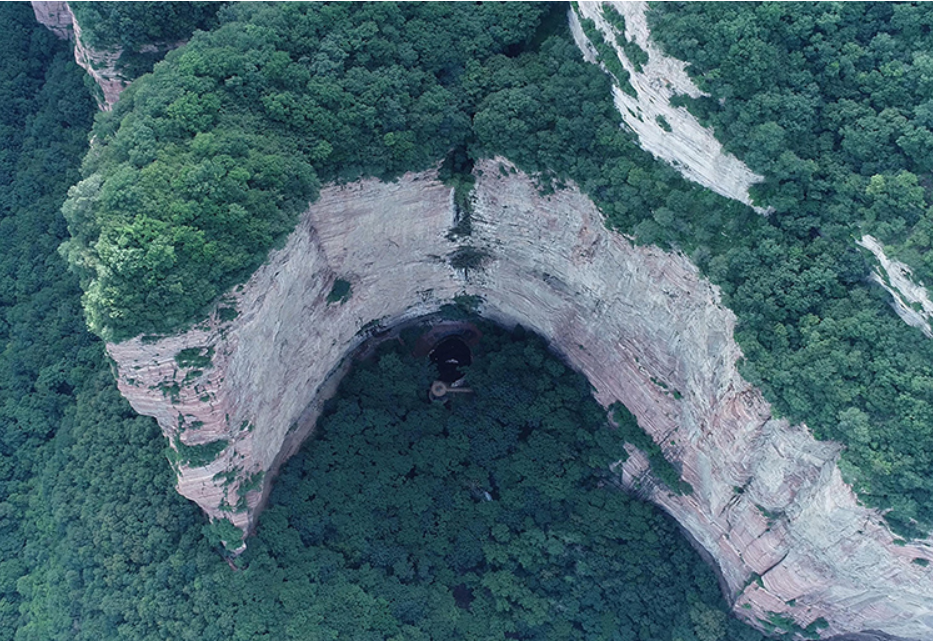
The purplish-red arc-shaped cliff wall now before you is the world’s largest natural echo wall, which was included in the Guinness Book of World Records in 1997. It was discovered in 1988. Viewed from the top of the cliff, its naturally curved cliff body encloses the sky into a semi-cylindrical shape. Interpreted from aerial survey images, it looks much like the longitudinal section of a deep well. It is 103 meters high, with an arc length of 310 meters and a curvature of 250 degrees. Standing below the Echo Wall, no matter where you make a sound, a clear echo will come back, just like your own original voice. The echoes overlap and resonate repeatedly through the valley, lingering without end. Now, please feel free to shout aloud and listen carefully—can you hear another real you responding to your voice?
So how was this Echo Wall formed? According to experts, before the Echo Wall took shape, the mountain had undergone several major crustal changes and a long period of water erosion under a warm and humid rainforest climate. As early as 70 million years ago, under the strong influence of the Yanshan orogenic movement, the rock mass was fractured, and north-south vertical fissures developed. During the crustal movement about 3 million years ago—the Himalayan orogenic movement—the peaks rose rapidly, and the fractured cliff walls gradually collapsed during the rapid uplift. Over the following 3 million years, streams from the tropical rainforest climate poured down along the broad third-tier cliff wall, gradually carving out the basic shape of the arc-shaped cliff wall.
Over the past 200,000 years, the climate gradually changed and the four seasons became distinct. In winter, water filling the rock fissures froze and expanded, generating tremendous pressure. Through repeated freezing and thawing, the rock fissures continued to widen until the rocks broke apart, causing rockfalls. This process is known as frost wedging. The central rock mass fractured and collapsed, and was then carried away by flowing water. Frost wedging continued to extend toward both sides, forming progressive collapse. The exposed rock bodies on both sides gradually collapsed under weathering. The closer the rock mass was to the center of frost wedging, the stronger the collapse became, and the more easily the remaining rock body was preserved. This is the reason why the Echo Cliff formed a regular arc-shaped cliff wall in the horizontal direction. The rock of Echo Cliff is brittle yet hard. Under the effects of horizontal crustal movement and vertical uplift and subsidence caused by internal forces, cracks in the mountain rock developed both horizontally and vertically. At the base of Echo Cliff lies a layer of mudstone that is prone to weathering and peeling. The base was hollowed out before the main mountain body, interacting with the frost-wedging collapse from the cliff top downward. These upper and lower processes corresponded with each other, causing the rock body to collapse almost vertically. This explains why Echo Cliff is nearly vertical from top to bottom.