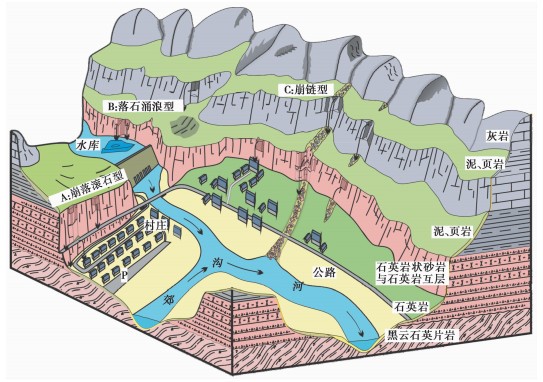
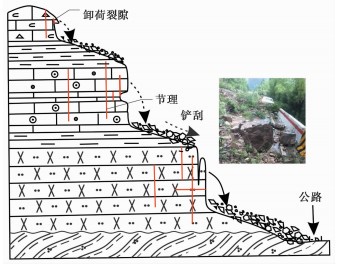
The Zhangshiyan landform is a non-renewable geological natural heritage formed, developed, and preserved over the long geological history of Earth’s evolution under the influence of various internal and external geological processes. Geological structure is the material basis for the formation of the Zhangshiyan landform, while endogenic and exogenic geological processes are the driving forces behind its formation and development.
(1) Hard lithology, gentle strata occurrence, and well-developed joints form the material basis for the development of the Zhangshiyan landform
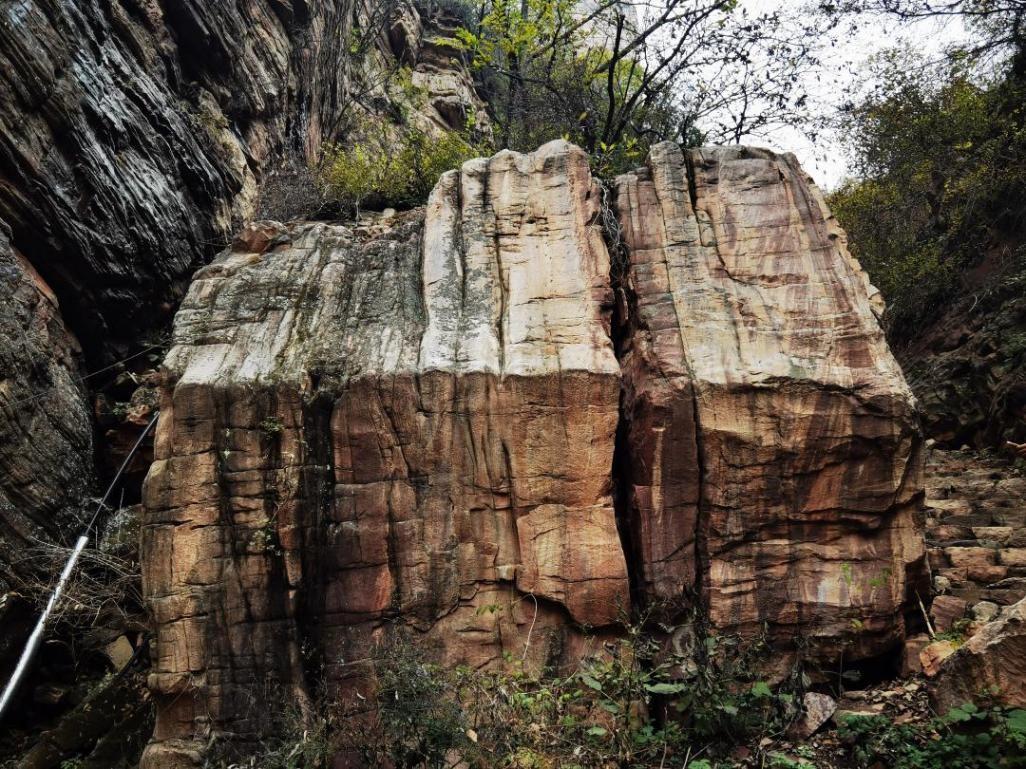
The strata in which the Zhangshiyan landform developed are mainly composed of Mesoproterozoic Changcheng System quartz sandstone, feldspathic quartz sandstone, and sandy shale, with a total thickness of more than 400 meters. These rock layers are mainly composed of medium- to thick-bedded quartz sandstone, cemented by siliceous and ferruginous materials, and have undergone slight metamorphism, resulting in hard lithology. Vertically, they can generally be divided into three sections. The lower section consists of conglomeratic sandstone and quartz sandstone, with uniform and compact lithology, belonging to littoral facies. The middle section consists of feldspathic quartz sandstone, siltstone, and silty shale, belonging to estuarine delta facies. The upper section consists of medium- to coarse-grained feldspathic quartz sandstone and quartz sandstone, with uniform and compact lithology, belonging to tidal flat facies. The vertical variation in lithology provides the basic conditions for differential erosion and the development of stepped cliffs in the Zhangshiyan area. Among them, the lower and upper strata dominated by quartz sandstone form steep cliffs, while the middle strata dominated by siltstone and silty shale form terrace-like ledges. Another condition allowing the steep cliffs formed by hard, erosion-resistant rocks to extend over long distances in the Zhangshiyan area is that they are located on the western limb of the axis of the Zanhuang compound anticline, or the western limb of the dome core. Here, the strata occur gently, and a group of conjugate X-joints composed of N5ºW-trending and N75ºE-trending joints is well developed. The gentle strata occurrence allows the long red cliff walls of the Zhangshiyan landform to develop and extend, while the well-developed, nearly perpendicular conjugate X-joints give the Zhangshiyan landform its distinctive sharp-edged features.
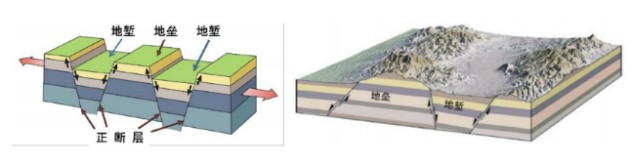
(2) Strong fault-block uplift is an important prerequisite for the development of the Zhangshiyan landform
Since the Quaternary, the mountains in this area have undergone intense uplift under the influence of strong activity along the eastern and western boundary faults of the Taihang Mountains. By comparing ancient geomorphic surfaces developed on the mountaintops and at the mountain foot, the uplift amplitude can be estimated to exceed 1,300–1,400 m. The strong uplift increased the relative relief of the mountains, thereby providing prerequisite conditions for exogenic geological processes to shape the Zhangshiyan landform.
(3) Intense climate fluctuations and significant alternation between dry and wet conditions are the main driving forces shaping the Zhangshiyan landform
Since the Quaternary, several glacial periods have occurred in this area. According to research, there have been at least four major glacial periods since the Quaternary, while smaller-scale cold periods occurred more than 20 times. During glacial climates, the mountains in the area experienced strong physical weathering. Studies show that during the Quaternary glacial periods, the climate was cold and dry, with average temperatures more than 7°C–10°C lower than those of interglacial periods. Precipitation was limited and mainly occurred as sudden rainstorms. The cold and dry climate reduced surface vegetation and intensified rock collapse, while sudden rainstorm floods enhanced headward erosion and downcutting by rivers, accelerating the development of the Zhangshiyan landform. During interglacial periods, the climate became warm and humid, with smaller temperature fluctuations and increased precipitation, but fewer rainstorms. Therefore, the development process of the Zhangshiyan landform slowed during interglacial periods and was modified to a certain extent. The Zhangshiyan landform is the result of the combined effects of gravitational and fluvial geomorphic processes under these fluctuating climatic conditions.
(4) Gravity and rock collapse
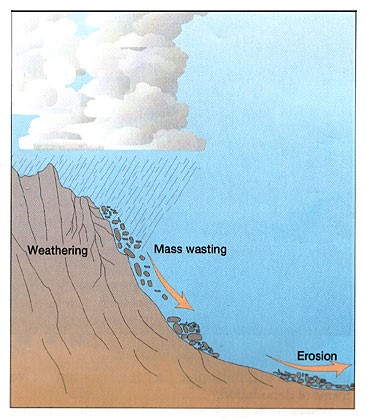
A large number of rock collapse phenomena can be observed in the park. This refers to the sudden detachment, falling, rolling, and accumulation of rock and soil masses from steep slopes under the action of gravity. As the mountains continuously collapse and retreat, Zhangshiyan’s sheer cliffs, mesa mountains, lane-like valleys, stone pillars, peak forests, and geomorphic landscapes at different stages of evolution have gradually formed.