The under-forest economy refers to an eco-friendly economy that relies on forests, forest land, and their ecological environment, follows the principle of sustainable management, and is mainly characterized by compound operations. It includes under-forest planting, under-forest breeding, collection and processing of related products, and utilization of forest landscapes. Developing the under-forest economy is an important measure to promote the transformation of “lucid waters and lush mountains” into “invaluable assets,” achieve rural revitalization, and boost consumption.
In October 2024, during his inspection tour in Fujian, General Secretary Xi Jinping emphasized the need to “deepen reform of the collective forest rights system, develop forest food and the under-forest economy, and continuously explore and cultivate forests as a ‘food bank and wealth bank.’” This year’s Government Work Report proposed developing the under-forest economy, promoting the extension and efficiency improvement of rural specialty industry chains, linking and supporting farmers, and broadening channels for farmers to increase income. In March this year, the General Office of the CPC Central Committee and the General Office of the State Council issued the Special Action Plan for Boosting Consumption, clearly identifying the development of the under-forest economy according to local conditions as one of the important ways to promote farmers’ income growth.
What is the current state of China’s under-forest economy? What problems exist? How can it be made larger and stronger? With these questions in mind, reporters conducted in-depth field research and interviews in forest areas of Hunan, Guangxi, Fujian, Yunnan, and other places.
On May 11, at the demonstration base of the under-forest economy industrial park of Xujiang Forest Farm in Guangchang County, Fuzhou City, Jiangxi Province, workers were picking three-dimensionally cultivated stone ear mushrooms. Photo by Zeng Henggui, China Economic Vision
What to Plant Under the Forest
“When spring rain comes, tender shoots emerge.” Every year from February to May, bamboo shoot farmers in Shaxian District, Sanming City, Fujian Province, become busy. They walk into bamboo forests, dig up fresh shoots covered with rain and dew, place them in bamboo baskets, send them to “bamboo bases,” transport them down the mountain for cleaning and peeling, and then gather them at enterprises and industrial parks. From there, the shoots are sold across the country and become delicacies on people’s dining tables.
Under-forest planting refers to planting activities carried out within forests, including artificial planting and the tending of wild plant resources. According to information from the National Forestry and Grassland Administration, forest areas across China have explored various under-forest planting models, including forest-medicine, forest-fungi, forest-tea, forest-fruit, forest-vegetable, forest-seedling, forest-grass, and forest-flower models.
The planting of under-forest economic crops is greatly affected by natural conditions such as light, soil, and water sources. Forest land environments often feature large elevation differences, uneven sunlight, and complex water and soil conditions. What economic crops are suitable, which varieties bring higher returns, and how to ensure stable yield and quality are questions that forest areas in different places need to answer.
Adapting measures to local conditions, making full use of strengths while avoiding weaknesses, and winning through distinctive features may be a better choice.
Take Yunnan as an example. Located on a low-latitude plateau, Yunnan has diverse vertical climates, an excellent ecological environment, and abundant species resources, making it suitable for the growth of many economic crops. Yunnan currently has 370 million mu of forest land, 63% of China’s higher plants, and 59% of the country’s species resources. The total number of traditional Chinese medicinal resources and medicinal plants alone accounts for more than half of the national total. Its unique climate conditions and rich forest resources provide a solid foundation for the development of Yunnan’s under-forest economy.
In recent years, Yunnan has built on its own advantages, and under-forest economic models represented by wild edible mushroom collection and forest-grass Chinese medicinal herb planting have flourished. The province’s total output value of under-forest economy products such as edible fungi, bamboo shoots, and Chinese medicinal herbs increased from 65 billion yuan in 2019 to 148.1 billion yuan in 2023, ranking among the top in China. Among them, the suitable growth area and output of wild edible fungi both rank first nationwide, while the planting areas of forest medicinal crops such as amomum tsao-ko, star anise, and gastrodia each exceed 100,000 mu.
“Small and scattered” was once a bottleneck restricting the development of the under-forest planting industry. Many forest farmers live year-round in remote mountainous areas and have delayed access to information, making it difficult for them to accurately grasp market conditions and trends. As a result, they often blindly imitate others and choose similar planting or breeding varieties. Many products planted under forests in forest farms are still mainly produced and sold locally, with producers passively waiting for buyers to come to them, making it hard to avoid problems such as poor sales and low prices. The “small and scattered” model also makes it difficult to popularize and improve professional technologies, and issues such as low yield and pests and diseases cannot be addressed promptly and effectively.
“These problems can be solved through a cooperation model of ‘enterprise + forest farm + base + forest farmers.’ Enterprises are responsible for seedling breeding, technical research, guaranteed-price purchase, and market connection. Forest farms provide under-forest space and daily management and protection. Forest farmers are responsible for specific planting and breeding production. Different parties can join together, give full play to their respective advantages, form a community of shared interests, and implement standardized production, thereby reducing market risks and achieving mutual benefits,” said Tang Tonghua, Deputy General Manager of Fujian Hekang Medicinal Plant Technology Co., Ltd.
Fujian is a key collective forest region in southern China and is known as a place of “eight parts mountains, one part water, and one part farmland.” It has 132 million mu of forest land and 5,550 naturally distributed plant species. Abundant forest resources provide broad space for developing the under-forest economy. The province has vigorously promoted the “enterprise + forest farm + base + forest farmers” cooperation model, and the under-forest planting industry is developing well. Taking bamboo shoots as an example, Fujian’s annual bamboo shoot output reaches 2.136 million tonnes. Moso bamboo shoots, green bamboo shoots, thunder bamboo shoots, ma bamboo shoots, sour bamboo shoots, bitter bamboo shoots, and many other varieties are fresh, tender, and delicious.
In fact, the market is far more complex than expected. Even under-forest planting projects that started early and already have a certain ability to resist risks may encounter unexpected impacts. Forward-looking research and planning for sustainable industrial development are highly necessary.
In recent decades, rubber planting has developed rapidly in Yunnan. However, since 2011, market conditions have changed dramatically, and global natural rubber prices have remained low. The benefits and industrial competitiveness of rubber tree planting have declined sharply, severely dampening the enthusiasm of rubber enterprises and farmers. Abandonment of rubber plantations, suspension of tapping, and even conversion to other crops have become relatively serious. In response, the government of Xishuangbanna Dai Autonomous Prefecture in Yunnan Province and relevant research institutions promptly carried out the collection, utilization, and industrial research and development of under-forest resource plants, selecting a variety of shade-tolerant resource plants with potential economic value, such as Amorphophallus bulbifer, Stephania epigaea, Zingiber truncatum, amomum with coriander aroma, red cardamom, large-leaf zanthoxylum, and stemona root.
About one kilometer from North Ring Road in Jinghong City, Xishuangbanna Dai Autonomous Prefecture, reporters saw a 1,054-mu environment-friendly ecological rubber plantation demonstration base of the Yunnan Institute of Tropical Crops. Here, the planting row spacing of rubber trees has been expanded from the traditional 8 meters to more than 20 meters, and the above-mentioned economic crops are interplanted between rubber trees. With such a layout, even when the rubber market is poor, the carefully selected interplanted economic crops can still generate good economic returns.
At a Chinese medicinal herb planting base under rubber forests in Mengla County, Xishuangbanna Dai Autonomous Prefecture, Yunnan Province, Stephania epigaea is growing well. Photo by our reporter Lai Qichun
What to Raise Under the Forest
Forest areas with good ecology, fresh air, and vast space are ideal places for free-range forest livestock, forest poultry, and forest insects.
Under-forest breeding mainly refers to ecological breeding activities carried out within forests by relying on forests, forest land, and their ecological environment, and following the principles of sustainable management and circular economy. It includes forest-poultry, forest-livestock, forest-bee, forest-fishery, and forest-specialty models. Dispatch data from the National Forestry and Grassland Administration show that under-forest planting and breeding across China produce about 4.9 billion forest poultry and more than 50 million forest livestock each year.
Vast forests are ideal places for raising forest livestock, forest poultry, and forest insects. However, forest areas across the country face many tests when developing under-forest breeding industries.
How to select suitable improved breeds is the first test faced by different regions in developing under-forest breeding.
During interviews in Guangxi’s forest areas, reporters heard the story of how a forest farm’s deer farming project went from desperation to revival.
Nanning Arboretum has only 58,000 mu of state-owned forest land, making it the smallest of the 13 state-owned forest farms directly under Guangxi Zhuang Autonomous Region, with nearly 30,000 mu being ecological public welfare forest. In 1997, Nanning Arboretum decided to break the situation of relying solely on timber and boldly tried the project of “raising northern deer in the south.” In 1999, Nanning Arboretum purchased 360 breeding deer and began self-breeding and self-raising, becoming one of the earliest units in Guangxi to introduce and breed sika deer. In 2004, the number of sika deer at Nanning Arboretum exceeded 550, and the deer farm was officially registered as Guangxi Liangfengjiang Sika Deer Industry Co., Ltd., becoming a comprehensive enterprise integrating sika deer breeding and deep processing of related products. However, no one expected sika deer farming to be so difficult. Since the deer farm opened, the survival rate of fawns had long remained at a low level of 20% to 30%. By 2018, only 20 sika deer remained.
The turning point came in 2021. That year, the Forestry Bureau of Guangxi Zhuang Autonomous Region proposed the creation of “one forest farm, one product” for the under-forest economy. After in-depth analysis, Nanning Arboretum concluded that the setback in the sika deer breeding industry was caused by problems with the deer breed.
In 2022, Guangxi Liangfengjiang Sika Deer Industry Co., Ltd. was officially renamed Guangxi Luyoushan Ecological Breeding Co., Ltd. After conducting in-depth field visits to improved sika deer breeding farms in other regions, the company chose to introduce improved breeds such as Dongda sika deer, promptly optimized and renewed the structure of its deer population, and formed a professional technical team with the Guangxi Veterinary Research Institute. Scientific methods were adopted for breeding, domestication, and disease prevention. Nanning Arboretum made full use of more than 10,000 mu of forest land to implement near-natural breeding. The sika deer feed independently throughout the year, run freely in the forest area, and grow healthily.
In just a few years, Nanning Arboretum’s sika deer breeding industry came back to life. In 2024 alone, it successfully bred 218 sika deer fawns independently, with a survival rate of over 90%. The total stock quickly expanded to nearly 1,000 deer. Luyoushan became the largest sika deer breeding base in Guangxi and a good example of “raising northern deer in the south” for surrounding areas to learn from.
For the under-forest sika deer breeding industry, Nanning Arboretum has three promising visions: first, to cultivate improved sika deer breeds for southern China and reach a breeding scale of 30,000 deer; second, to create sika deer wine with an annual output of at least 400,000 jin; and third, to build Luyoushan Scenic Area into a popular tourist attraction in Guangxi and a model of integrated development of “industry + culture and tourism” in the region.
“Improved breeds are the key to successful under-forest breeding,” said Yu Zhuguang, Director of Liangfengjiang National Forest Park. He told reporters that starting in 2025, the sika deer breeding project is expected to generate annual operating revenue of 30 million yuan.
Improved breeds alone are not enough without good methods.
In the forested areas of northwestern Hunan, reporters heard a story about mobile beekeeping. Shimen County, located in the northwest of Hunan Province, has an average elevation of more than 500 meters and is home to more than 180 rare animal and plant species under first- and second-class national protection. Shimen has 450,000 mu of economic forests, with soapberry, Chinese gallnut, and winter osmanthus growing throughout the forests. Flowers bloom continuously throughout the year, providing abundant wild nectar sources for bees. Wen Jili, Deputy Director of Shimen County Forestry Bureau, told reporters that in recent years, Shimen County has adopted a “cooperative + base + farmers” development model and developed more than 110,000 colonies of under-forest bees, with an annual output of over 1,800 tonnes of high-quality honey and an output value of nearly 200 million yuan.
At the Shimen Chinese honeybee industrial park, where flowers bloom and bees fly, reporters met the couple Qin Shiyong and Liao Xiaoying, both in their 50s. Qin inherited beekeeping from his father. At the end of 2013, his elderly father handed 11 bee boxes to him. Qin then raised funds to buy another 30 boxes and began his beekeeping career. Fortunately, that year he expanded to 100 boxes, harvested more than one tonne of honey, earned 150,000 yuan, and became well known. Unexpectedly, after just one winter, some bees flew away and others died, leaving Qin nearly bankrupt. At his most difficult time in 2015, he even had to spare time to drive trucks for others to support his family.
After setbacks, Qin Shiyong realized that good methods were essential for raising bees well. The method was: wherever flowers bloom, the bee boxes should be moved there. Determined, he moved all 70 boxes of his bees to a faraway mountain rich in nectar sources. That year, he harvested more than 1,200 jin of honey. Since then, Qin Shiyong and Liao Xiaoying have followed the flowers and traveled year-round among the mountains and rivers of Shimen.
In 2016, Qin Shiyong founded a professional beekeeping cooperative. Today, his cooperative has attracted more than 400 members, with an annual output value of 13 million yuan. The cooperative adopts the “cooperative + base + farmers” model, providing members with beekeeping technical training, unified supply of beekeeping equipment and bee colonies, and fixed-price honey purchase services, leading many forest farmers to become prosperous through hard work.
During interviews, reporters learned that forest livestock, forest poultry, and forest insect breeding industries have generally emerged in forest areas across the country. In Shaxian, Fujian alone, there are more than 1,000 beekeepers, with bee colonies covering over 90% of forest land and annual honey output value reaching 12 million yuan. The local leading under-forest breeding enterprise Datong Agriculture and Animal Husbandry Development Planting and Breeding Base covers 3,500 mu, produces about 120,000 native chickens and about 15 million native eggs annually, and has developed two major brands, “Lezi” and “Taojinshan.”
When developing under-forest breeding, the foraging behavior of poultry and livestock such as chickens, cattle, and sheep can damage the roots of under-forest herbaceous plants to some extent. Scientific breeding models must be adopted to avoid negative ecological disturbance. Wuding County, Chuxiong Yi Autonomous Prefecture, Yunnan Province, has developed under-forest breeding of 4.59 million Wuding strong chickens, with an output value of over 500 million yuan, driving 34,000 farm households across the county to develop chicken farming. Zhang Dewen, Chairman of Wuding Zhenji Agricultural Technology Development Co., Ltd., believes that to reduce the ecological pressure of under-forest breeding on a single area, measures such as batch-based free-range breeding and seasonal adjustment can be adopted. “Time should be left for vegetation to recover naturally and to avoid excessive trampling and soil degradation. This model not only ensures activity space for the chickens, but also significantly reduces continuous damage to forest land.”
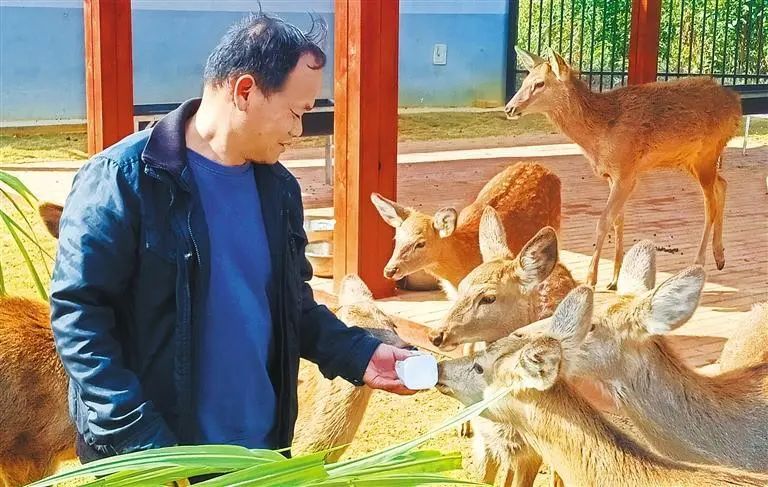
A keeper at Guangxi Liangfengjiang National Forest Park feeds a sika deer fawn. Photo by our reporter Huang Junyi
How to Refine Processing
How many products can be developed from a single hibiscus flower? Ziyang District in Yiyang City, Hunan Province, gives the answer: eight.
Ziyang District has nearly 10,000 mu of hibiscus. The local area has developed products such as hibiscus flower banquets, hibiscus tea, hibiscus wine, hibiscus noodles, hibiscus cakes, hibiscus coffee, hibiscus bath products, and hibiscus cosmetics, all of which are popular in the market. According to Peng Yongjun, Deputy Director of Ziyang District Forestry Bureau, the local area has also carefully created a hibiscus culture and tourism route featuring “hibiscus flower sea + specialty homestays + cultural experiences,” forming a hibiscus tourism economic belt. A model integrating the primary, secondary, and tertiary industries of hibiscus has begun to take shape, with the comprehensive annual output value of the hibiscus industry exceeding 100 million yuan. The output value per mu of hibiscus reaches as high as 15,000 yuan, and the annual per capita disposable income of forest farmers reaches 26,000 yuan.
Through field research in forest areas across China, reporters found that to make the under-forest economy larger and stronger, it is necessary to expand scale, extend the industrial chain, develop deep processing, and build strong brands. Among these, giving full play to the advantages of local raw materials is especially important.
Polygonatum cyrtonema in Anhua County, Hunan Province, is a successful example. According to Xia Yanzhao, an engineer from the Industrial Development Section of Anhua County Forestry Bureau, Anhua County currently has 126,000 mu of under-forest Polygonatum cyrtonema planting, with an annual output of 20,000 tonnes and a comprehensive output value of 3.21 billion yuan. It has become the county with the largest under-forest planting area of Polygonatum cyrtonema in China. Local planting of Polygonatum cyrtonema under Chinese fir forests yields more than 4,000 jin per mu annually, with an average annual income of over 5,000 yuan per mu.
In Guangyi Community, Zhexi Town, Anhua County, reporters met Li Dingqiu. During the poverty alleviation campaign in 2017, Li returned to his hometown to serve as Party branch secretary, signed industrial assistance agreements with poor households, took the lead in establishing Anhua Yisheng Chinese Medicinal Materials Professional Cooperative, and developed 1,450 mu of under-forest Polygonatum planting based on the local conditions of being a mountainous and reservoir area. The project produces more than 1,000 tonnes of fresh Polygonatum annually and increases the village collective economy by more than 3 million yuan each year.
With a stable and controllable supply of raw materials, Li Dingqiu then took the lead in establishing Guangxi Agricultural Company, purchased equipment such as vacuum stretch-film packaging machines and fully automatic ultrafine cell-wall-breaking grinders, and built six Polygonatum deep-processing production lines. At present, Guangxi Agriculture has established the “Chenfenggu” brand and developed six major series with 13 products, including Polygonatum tea, Polygonatum wine, raw Polygonatum slices, Polygonatum preserves, Polygonatum noodles, and Polygonatum small-molecule peptide liquid drinks. These products are sold across the country and are well received by consumers.
For under-forest products, deep processing and brand building also need to be seamlessly connected with market demand or local industrial chains as much as possible.
Fujian has successful examples. Shaxian snacks are famous across China. The local area has built a 30,000-mu planting base for Shaxian snack ingredients, focusing on the under-forest planting and deep processing of snack ingredients such as Dioscorea nipponica, Ficus hirta, milk root, Polygala fallax, and Dendrobium officinale. In the process of supporting the Shaxian snack industry, it has successfully created a public brand of under-forest ecological products such as “Shayi Treasures,” including medicinal materials for Shaxian snack stew pots. In Wuping County, Longyan City, Fujian Province, the local area has integrated rural revitalization with the creation of distinctive featured products and built a new model integrating planting, processing, cultural tourism, and study tours across the primary, secondary, and tertiary industries. It has developed 42,400 mu of purple Ganoderma lucidum planting, has 18 enterprises engaged in preliminary processing of purple Ganoderma, and has developed products such as Ganoderma tea, Ganoderma spore powder, Ganoderma capsules, and Ganoderma beverages. By holding Ganoderma picking festivals and Ganoderma selection activities, it has promoted rural tourism. It is understood that Fujian’s under-forest economy has successfully built well-known brands such as the China Famous Trademark “Zherong Radix Pseudostellariae” and national geographical indication certified brands including “Yishanlian Yong’an Anoectochilus,” “Guanzhishan Dendrobium officinale,” “Shaowu Polygonatum,” and “Wuping Ganoderma.”
For under-forest products, deep processing, brand building, and industrial demonstration are also very important.
Guangxi is a typical example in this regard. Shi Fujun, Chief Engineer of the Forestry Bureau of Guangxi Zhuang Autonomous Region, told reporters that, so far, Guangxi has built 11 national-level under-forest economy demonstration bases, five Guangxi under-forest economy demonstration counties, 26 Guangxi high-quality under-forest economy demonstration bases, and 15 autonomous-region-level modern industrial demonstration parks related to the under-forest economy, successfully attracting social capital to enter mountains and forests. At present, Guangxi has 45 enterprises with under-forest economy output value exceeding 10 million yuan. The Forestry Bureau, the Traditional Chinese Medicine Administration, and six other departments of Guangxi Zhuang Autonomous Region jointly released the “Ten Guangxi Flavors” authentic medicinal materials and regional specialty medicinal material varieties. Guangxi has now created geographical indication products such as Ganoderma lucidum and golden camellia, issued a batch of local standards including technical procedures for under-forest planting of Dendrobium officinale and red cone fungus, and Xing’an County’s technology of “planting Ganoderma under moso bamboo forests” has obtained a national patent. The region now has 192 well-known under-forest economy brands, and products such as “Gaofeng Ganoderma,” “Pubei Red Cone Fungus,” “Fangcheng Golden Camellia,” “Huanjiang Beef Cattle,” and “Paiyangshan Star Anise Chicken” have been highly favored at exhibitions and sales events such as the World Forestry Industry Conference and international agricultural expos.
What to See in the Forest
Sitting on a small forest train, enjoying a refreshing breeze, and traveling through vast green forests is truly pleasant. This is Guangxi Gaofeng Forest Park.
Gaofeng Forest Farm was founded in 1953. It has an operating area of 1.5 million mu and forest stock volume of 7 million cubic meters, making it the largest state-owned forest farm in Guangxi. Huang Zhenggen, Deputy Director of Gaofeng Forest Farm, told reporters that in recent years, the forest farm has raised 1.2 billion yuan and built a forest park covering more than 10,000 mu. The park has green boardwalks, starry-sky camping, and a glass sky bridge spanning two mountains, allowing visitors to enjoy the magnificent scenery of high mountains and forest seas. Its distinctive landscapes attract tourists from across the country, and Gaofeng Forest Park receives 400,000 visitors annually.
Gaofeng Forest Farm is one of many forest farms across China that are vigorously developing forest tourism. The 2024 China Land Greening Bulletin released by the Office of the National Greening Committee shows that in 2024, China received 2.76 billion eco-tourism visits, up 9.1% year on year. Data from the National Forestry and Grassland Administration show that by 2023, China had more than 7,000 forest parks at various levels.
Forest tourism is flourishing across China and showing promising development, but it has also created new problems. How to avoid homogeneous competition has become a major challenge for different regions in developing forest tourism.
“Selling” knowledge in forest areas may be a good way to avoid homogeneous competition and achieve differentiated development.
Guangxi State-Owned Qipo Forest Farm has made its forest tourism business thrive by “selling” knowledge. According to Zhou Qihua, Deputy Director of Qipo Forest Farm, the farm was founded in December 1952 and is a large Class-I state-owned forest farm directly under the Forestry Bureau of Guangxi Zhuang Autonomous Region. It currently has 728 employees, operates 830,000 mu of forest land, mainly grows tree species such as pine, Chinese fir, eucalyptus, and Michelia macclurei, has a forest coverage rate of 79.7%, and forest stock volume of 6.13 million cubic meters.
Objectively speaking, the natural scenery of Qipo Forest Farm is not particularly outstanding among China’s many forest farms. How could it break through in forest tourism? Through research, they found that their forest land is home to many nationally protected animals and plants, such as Cibotium barometz, Mussaenda pubescens, Chinese tulip tree, leopard cat, tiger frog, red junglefowl, and silver pheasant. These were valuable resources for developing forest study tours. As a result, the Qipo Forest Farm study-tour base, covering more than 20,000 mu, was established. The stories of the Pinecone Kingdom, the small world of bees, identification of under-forest Chinese medicinal herbs, soilless cultivation, integrated water and fertilizer demonstrations, under-forest multi-layer management models, vine plant science popularization, forest fire prevention, and many other study-tour projects have made urban children reluctant to leave. In 2023, Qipo Forest Farm received more than 80,000 forest study-tour visitors. By taking the lead in integrating forest tourism with nature education, Qipo Forest Farm has successively won honors such as National Key Forestry Leading Enterprise, Outstanding Contribution Unit to China’s Forestry Industry, National Forest Management Pilot Unit, Top Ten Forest Farms in China, National Advanced Collective in Greening, and one of the first batch of “Magnificent Forest Farms” in Guangxi.
Developing forest wellness is another approach to avoiding homogeneous competition and achieving differentiated development.
Forest wellness refers to service activities based on forest ecological environments that utilize forest ecological resources, landscape resources, food and medicinal resources, and cultural resources, and integrate them with medicine and health preservation to provide healthcare, rehabilitation, convalescence, and healthy elderly care. In 2021, the General Office of the State Council issued the Guiding Opinions on Scientific Greening, which clearly proposed making reasonable paid use of state-owned forests, grasslands, and landscape resources to develop eco-tourism and forest wellness, thereby improving the comprehensive benefits of forestry and grassland resources. In the Industrial Structure Adjustment Guidance Catalogue (2024 Edition) released by the National Development and Reform Commission, forest wellness is listed as an encouraged category.
The Forestry and Grassland Industry Development Plan (2021–2025) of the National Forestry and Grassland Administration proposes that by 2025, the total number of forest wellness service visits should exceed 600 million. Currently, different regions have incorporated forest wellness into local forestry industry development plans and are actively exploring industrial development paths. Various integrated industrial models such as “wellness + cultural tourism,” “wellness + healthcare,” “wellness + sports,” and “wellness + insurance” have taken shape. Wellness services have been launched with forest food, forest medicinal materials, health preservation, rehabilitation and convalescence, healthy elderly care, leisure and recreation, health education, and sports fitness as their main contents. These services have extended the industrial chain of forest leisure tourism and promoted the development of outdoor sports and related facilities.
During field research, reporters found that forest wellness projects still face many difficulties in implementation due to issues such as construction land approval and ecological protection. From the perspective of the contradiction between ecological protection and development, forest wellness projects often involve nature reserves or ecologically sensitive areas, so localities are very cautious when developing such projects. Some places encourage development on low hills and gentle slopes and give priority to infrastructure and livelihood-related projects, while forest wellness projects often struggle to obtain land quotas because they are not classified as key projects. Meanwhile, long overall approval cycles also restrict the development of the under-forest wellness industry.
Some places developing forest tourism also face problems of excessive upfront investment and heavy debt pressure. Most forest areas are remote, with weak transport, accommodation, and other infrastructure. To develop forest tourism projects, large upfront investment is required for both hardware construction and market cultivation. During interviews, reporters found that one forest farm had borrowed as much as 1.8 billion yuan to build tourist roads, scenic spots, and catering and accommodation facilities in the forest area. Annual interest payments alone amounted to tens of millions of yuan, while current annual tourism revenue was only several million yuan. In response, industry insiders suggested that, given the large upfront investment and long payback period of forest tourism projects, forest areas in different places could introduce social capital to share risks and achieve common development.
How to Make Up for Weaknesses
During research and interviews in forest areas across the country, reporters found that although the under-forest economy has made great achievements, there are still many weaknesses that urgently need to be addressed.
— Insufficient variety development and utilization, as well as deep processing capacity.
China has more than 8,000 woody plant species, including over 500 tree species with food production functions, but only a small number of varieties have been developed and utilized, and output remains low. At present, the deep-processing rate of under-forest products is less than 30%, and the comprehensive utilization of deep processing remains to be further explored. For example, apricot kernels can be processed into edible oil and beverages. If gasification polygeneration technology is used, one tonne of apricot shells worth 700 yuan can be converted into products worth 2,500 yuan, including electricity, heat, activated carbon, and wood vinegar fertilizer.
— A shortage of scientific and technological talent, slow technology promotion, and mechanisms for industry-university-research-application cooperation that need improvement.
The technological level determines the value of the under-forest economy. At present, the under-forest economy in many places has formed multiple industrial types, including forest-medicine, forest-fungi, forest-poultry, forest-livestock, forest-fruit, forest-vegetable, forest-grain, forest-tea, forest-seedling, and forest-insect models, with notable achievements. However, in further improving technological content and achieving scaled and industrialized production, stable technical teams are still lacking. Specifically, under-forest planting and breeding still largely follow traditional methods, with insufficient mastery of scientific planting and breeding technologies. Scaled and industrialized development of the under-forest economy faces high costs and low efficiency. Product research and development innovation capacity is insufficient, achievement transformation is slow, product quality varies, and competitive high-quality production capacity has not yet formed, affecting the improvement of both output and quality of the under-forest economy. A complete scientific and technological support system for the under-forest economy has not yet been established. There is a shortage of grassroots forestry technical personnel, research facilities lag behind, technology promotion funds are insufficient, and advanced practical technologies are not being adequately promoted and popularized at the grassroots level.
— More financial support is needed to expand scale and strengthen brands.
Insufficient fiscal support, limited participation of financial capital, and narrow project funding channels are key constraints on making the under-forest economy larger and stronger. Mengla County, Xishuangbanna Dai Autonomous Prefecture, Yunnan Province, has more than 2.3 million mu of rubber forest and is China’s largest natural rubber planting county. At the local red-veiled stinkhorn mushroom demonstration base under rubber forests, Ye Jian, head of Mengla Linchuang Agriculture Co., Ltd., calculated an account for reporters: about 4,400 red-veiled stinkhorn mushroom sticks can be planted on one mu of land, with a total investment of 46,000 yuan. Each mushroom stick yields an average of 0.2 jin of fresh stinkhorn mushroom, so 880 jin can be harvested. Calculated at an average of 70 yuan per jin, output value can reach 61,600 yuan, and net profit per mu can reach 15,600 yuan. Both principal and profit are expected to be recovered after the first harvest. From the perspective of return rate, under-forest planting of red-veiled stinkhorn mushroom has great potential. To better expand industrial scale, Mengla County is exploring the establishment of a forest rights acquisition and reserve institution to provide forest rights mortgage loan guarantee services for forest farmers, reduce bank loan risks, and increase banks’ willingness to issue loans. It has also introduced “forest rights mortgage loans,” long-term and low-interest financial products suited to forestry characteristics, with loan terms of up to 30 years, to solve the mismatch between long forestry production cycles and loan terms.
Through persistent efforts, some weaknesses in the under-forest economy are gradually being resolved. During interviews and research in Hunan forest areas, Wang Shunan, a fourth-level researcher at the Forestry Economic Development Center of the Hunan Provincial Forestry Bureau, shared good news with reporters: To attract urgently needed talent for the development of the under-forest economy as soon as possible, the Hunan Provincial Forestry Bureau has launched a special-post student program for grassroots forestry. Each year, it entrusts Central South University of Forestry and Technology and Hunan Environmental-Biological Polytechnic to enroll 500 new students from among those who take the national college entrance examination and meet the unified admission score requirements. These students are admitted with staffing quotas, and their tuition and accommodation fees during study are supported by provincial finance. This policy has received a positive response from applicants, and competition is fierce, directly driving the steady rise of admission scores at the two institutions.
Wu Jianbo, Director of the Hunan Provincial Forestry Bureau, believes that to address the weaknesses of the under-forest economy, it is necessary to adhere to market leadership and government guidance, use market demand to guide the development direction of the under-forest economy, promote precise matching between supply and demand, and ensure that under-forest products can be produced, sold well, and generate benefits. It is also necessary to strengthen government guidance and supervision, integrate project funds, increase support, and build an under-forest economy development pattern in which the government builds the platform, enterprises play the leading role, and farmers participate. In terms of products, it is necessary to adapt to local conditions and highlight distinctive features, fully consider climate conditions, resource endowments, and development foundations, identify leading under-forest economy products by category and region, build on the concept of “one county, one specialty,” explore new business forms such as forest tourism, study tours, and wellness, and carefully create a batch of specialty brands with ecological production areas, green products, integrated industries, and efficient output.
In the view of Wu Liangfeng, Director of the Forestry Reform and Industrial Development Division of the Fujian Provincial Forestry Bureau, to make the under-forest economy larger and stronger, it is necessary to strengthen policy support and factor guarantees and enhance the endogenous momentum of under-forest economy development. On the one hand, efforts should focus on removing bottlenecks and pain points in under-forest economy investment to stimulate enthusiasm among all types of capital to participate in its development. On the other hand, efforts should strengthen spatial expansion and integration of the three industries to improve the benefits of the under-forest economy.
Yang Zhiqiang, Director of the Forestry Reform and Development Division of the Forestry Bureau of Guangxi Zhuang Autonomous Region, believes that development should be guided by market demand, take the development of medicinal and food products as a breakthrough point, rely mainly on existing large state-owned enterprises and pharmaceutical enterprises, promote clustered development of preliminary processing bases and refined comprehensive processing enterprises, accelerate the construction of integrated “production, supply, and sales” bases for the under-forest economy, build distinctive under-forest brands, and push the under-forest economy industry value chain toward the mid-to-high end.
A responsible official from the Department of Forestry and Grassland Reform and Development of the National Forestry and Grassland Administration said that China’s under-forest economy has achieved solid results. At present, its annual output value is about 1 trillion yuan, helping tens of millions of forest farmers increase income and become prosperous. Next, the National Forestry and Grassland Administration will continue to implement General Secretary Xi Jinping’s important instructions on the under-forest economy, further activate policy mechanisms, strengthen technological support, enhance production and sales services, ensure factor supply, increase support, promote coordinated development of forests as “four reservoirs,” advance high-quality development of the under-forest economy industry, promote farmers’ income growth and prosperity, and make the under-forest economy a true industry that enriches the people and supports green development.
(Source: Economic Daily)