Hebei: Making Every Effort to Win the Battle of the “Three-North” Shelterbelt Program
Hebei surrounds Beijing and Tianjin from within and borders the Bohai Sea from the outside. In the new-era battle of the “Three-North” Shelterbelt Program, it shoulders the important political task of taking the lead in winning the decisive battle against the Hunshandake Sandy Land. Since June 2023, Hebei has firmly upheld the concept that lucid waters and lush mountains are invaluable assets, vigorously carried forward the Saihanba Spirit, and steadily advanced the construction of the “Three-North” Shelterbelt Program, achieving phased results and painting a magnificent green picture across the land of Yanzhao.
Ecological construction achievements of Saihanba Mechanical Forest Farm Photo by Wang Long
Over the past two years, Hebei has completed 9.72 million mu of ecological construction tasks under the “Three-North” Shelterbelt Program. In 2023, Hebei was commended by the National Forestry and Grassland Administration for its outstanding performance in the battle of the “Three-North” Shelterbelt Program.
Adhering to High-Level Promotion and Building Joint Force for the Battle
The Hebei Provincial Party Committee and Provincial Government have always regarded ecological construction as a major historical responsibility and development opportunity. Since June 2023, Ni Yuefeng, Secretary of the Hebei Provincial Party Committee, and Wang Zhengpu, Governor of Hebei Province, have repeatedly presided over meetings of the Standing Committee of the Provincial Party Committee and executive meetings of the Provincial Government to study and deploy the construction of the “Three-North” Shelterbelt Program. For two consecutive years, they issued the No. 1 Chief Forest Ranger Order, comprehensively deployed the battle of the “Three-North” Shelterbelt Program, and visited key project areas for investigation and inspection, leading by example to promote the work.
The Provincial Government signed target responsibility agreements for sand prevention and control during the 14th Five-Year Plan period with all cities, and included the construction of the “Three-North” Shelterbelt Program in the 2025 government work report. The General Office of the Provincial Party Committee and the General Office of the Provincial Government issued the Implementation Opinions on Promoting the Construction of Key Ecological Projects Including the “Three-North” Shelterbelt Program. Coordination mechanisms for the “Three-North” Shelterbelt Program have been established at the provincial, municipal, and county levels, with responsible government leaders as conveners and relevant department heads as members, forming vertical linkage and horizontal coordination to advance project construction with full effort.
Mixed coniferous and broad-leaved afforestation under the forest canopy at Saihanba Photo by Wang Long
Together with relevant departments and Party committees and governments at all levels in the project areas, the Hebei Provincial Forestry and Grassland Administration responded promptly and mobilized its best forces. It prepared and issued the Phase VI Plan for the “Three-North” Shelterbelt Program in Hebei Province (2021–2030), planned five major projects including the decisive battle against sandy land on the southern edge of Hunshandake, the Yanshan Ecological Security Barrier, the Taihang Mountain Ecological Security Barrier, large-scale forest farms upstream of Baiyangdian Lake, and the Millennium Forest construction in Xiong’an New Area. This has formed a scientific layout of three major areas: the core battle zone, coordinated advancement zone, and consolidation and expansion zone. The plan sets a construction task of 56.08 million mu from 2021 to 2030, providing a clear roadmap for the orderly advancement of the “Three-North” Shelterbelt Program battle.
Strengthening Factor Guarantees and Adding Momentum to the Battle
To advance the construction of the “Three-North” Shelterbelt Program in an orderly manner, multiple departments in Hebei have worked together. The provincial finance, development and reform, forestry and grassland departments jointly issued the Several Measures on Fiscal Support for the Construction of the “Three-North” Shelterbelt Program and the Measures for the Management of Subsidy Funds for the “Three-North” Shelterbelt Program, continuously increasing provincial-level financial support and gradually establishing a stable and sustained funding policy support system. The matching funds for the 2024 integrated forestry, grassland, wetland, and desertified-land project implemented by the Provincial Department of Finance and the matching funds for the 2024 treasury bond project implemented by the Provincial Development and Reform Commission have both been allocated.
The Hebei Provincial Forestry and Grassland Administration specially established a leading group for the battle of the “Three-North” Shelterbelt Program, set up a provincial-municipal-county guidance mechanism by designated areas, and restored independent forestry and grassland institutions. Last year, 13 counties in the “Three-North” project area restored separately established forestry and grassland institutions, and 320 township forestry stations were newly added, providing strong organizational support for project construction.
In project implementation, Hebei has firmly grasped projects as the key driver, forming a rolling development pattern of “starting one batch, reserving one batch, and planning one batch.” In 2024, 12 key “Three-North” projects were implemented. In 2025, Hebei secured 34 key projects, with a total construction task of 4.29 million mu.
Seedling grafting at Chazi Nursery in the Mulan Forest Farm “Three-North” functional area, increasing local residents’ income Photo by Cheng Kaiyin
Meanwhile, Hebei has strengthened technological empowerment by launching the first batch of five “open competition” scientific research projects to tackle difficult issues such as degraded ecosystem restoration and reconstruction. It has promoted advanced and applicable technologies such as the “Hao’s Afforestation Method” to improve afforestation survival rates on difficult sites. At the same time, it has intensified research on superior tree and grass species, newly built three forest germplasm resource banks and six native tree species test bases, and renovated or expanded 14 provincial-level support nurseries.
Carrying Out Land Greening and Building a Stronger Green Foundation
When forestry and grassland thrive, ecology thrives. Hebei has deeply practiced the concept that lucid waters and lush mountains are invaluable assets, continuously promoted large-scale land greening, firmly established a systematic approach, coordinated the ecological protection and restoration of forests, grasslands, deserts, and wetlands, strengthened regional joint prevention and control, and steadily advanced the integrated protection and systematic governance of mountains, rivers, forests, farmland, lakes, grasslands, and deserts.
Pingshan County, Shijiazhuang strengthens the battle in the “Three-North” project area and uses drones to accelerate afforestation on sandy and rocky plots Photo by Wang Tiejun
Localities across Hebei have been bold in innovation and practice. The trend of land desertification has been effectively curbed, the regional ecological environment has continued to improve, and positive contributions have been made to the implementation of major national strategies. By the end of 2024, the pilot scale of sustainable forest management expanded to 346,000 mu, 2.3 times that at the end of 2023. In 2024, 1,000 villages were newly upgraded through greening improvements, and 214 provincial-level forest villages were newly established. A total of 33.835 million participants across the province took part in voluntary tree planting, equivalent to planting 99.53 million trees, further strengthening Hebei’s green foundation.
Shangyi County in Zhangjiakou City is located on the southern edge of the Hunshandake Sandy Land and serves as a frontline area for sand source control in the Beijing-Tianjin-Hebei region, giving it an extremely important ecological position. Relying on key ecological projects such as Phase VI of the “Three-North” Shelterbelt Program, it has scientifically carried out degraded wetland restoration. The water area of Chahannur Wetland, which had been dry for many years, has recovered to 37.7 square kilometers. The former “saline-alkali white” has been covered with “vibrant green,” and rare birds such as black storks and relict gulls have appeared frequently.
Saihanba Mechanical Forest Farm has received honors including Advanced Collective of the Three-North Shelterbelt Program, the United Nations’ highest environmental award “Champions of the Earth,” and the “Land for Life Award,” the highest honor in desertification control. It has built a solid green Great Wall around the Beijing-Tianjin region, creating a “Chinese model” for sand prevention and control and a “Chinese example” for global environmental governance. Hebei is becoming increasingly green.
The year 2025 marks the concluding year of the 14th Five-Year Plan and a critical year for implementing the battle of the “Three-North” Shelterbelt Program. Hebei plans to implement key project construction tasks covering 5.523 million mu, resolutely strengthening the ecological security barrier for Beijing, Tianjin, and Hebei.
Releasing Ecological Benefits and Supporting Rural Revitalization
The significant improvement of the ecological environment has built a bridge from “lucid waters and lush mountains” to “invaluable assets.” Hebei gives priority to ecological benefits, combines ecological and economic benefits, integrates forestry development with enriching the people, and focuses on quality and efficiency improvement. Based on local conditions, it develops specialty forestry industries such as economic forests, flowers, and under-forest economy, and firmly follows the path of green development featuring ecological industrialization and industrial ecology. Focusing on reform of the collective forest rights system, Hebei has accelerated the separation of ownership, contract rights, and management rights, further enhancing the vitality of forestry development. In 2024, the province newly developed and improved 600,000 mu of economic forests, newly developed 390,000 mu of under-forest economy operation area, and newly developed and improved 5.78 million square meters of flowers, all exceeding annual plans.
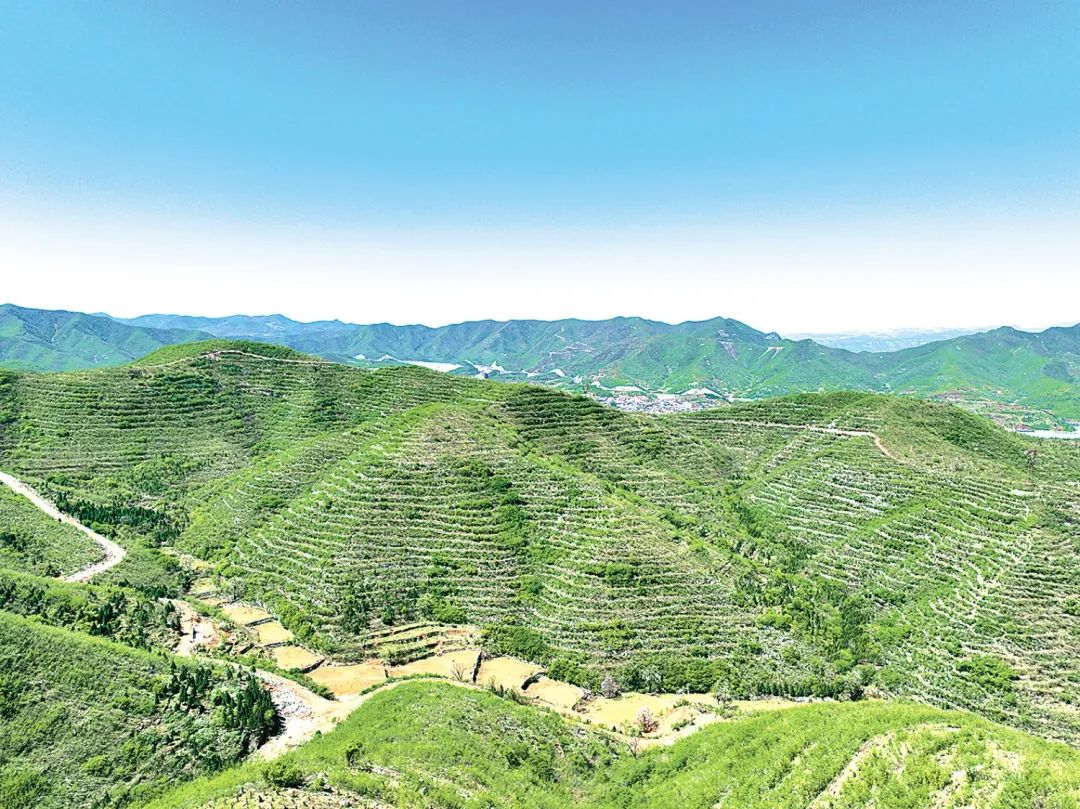
Jingxing County, Shijiazhuang focuses on the construction of the “Three-North” Shelterbelt Program and achieves notable results in creating a “sandy terraced field” model Photo by Wang Tiejun
Shijiazhuang City has vigorously developed specialty forestry industries. Relying on the “Three-North” Shelterbelt Program, it has greatly developed raw materials and processed forestry products such as walnuts, chestnuts, forsythia, jujubes, and sour jujubes. It has planted 300,000 mu of ecological economic forests such as forsythia and sour jujube, providing about 5,800 jobs for local people, with an output value of more than 3,000 yuan per mu, effectively promoting local economic development and farmers’ income growth.
Baoding City has taken the yellowhorn industry as a breakthrough point for comprehensive rural revitalization, integrating the planting of woody oilseed crops such as yellowhorn into ecological governance projects under the “Three-North” Shelterbelt Program. While completing national “Three-North” project construction tasks, it gives full play to the ecological value of yellowhorn through large-scale ecological economic forest parks, while also producing economic products and creating economic benefits.
Chengde City has accelerated the development of forestry carbon sinks, promoted Saihanba Group to become the first carbon-reduction product verification institution in the province, and held promotional activities suited to local conditions, such as the Saihanba Forest Music Festival and the Tourism Development Conference, achieving simultaneous improvement in both ecological value and economic value.
Mulan Weichang State-Owned Forest Farm has continued to promote the construction of the “Three-North” Shelterbelt Program, deepened reform of the collective forest rights system, and innovatively explored a model in which state-owned forestry drives private forestry. Through joint-investment under-forest afforestation, introduction of rare tree species, expansion of under-forest economy, and development of forestry carbon sinks, it has activated the endogenous momentum of private forestry development. Each year, the forest farm provides more than 240,000 direct labor opportunities in resource protection and cultivation, increasing local farmers’ income by over 37 million yuan annually on average. It has also driven surrounding residents to develop nearly 10,000 mu of greening seedlings, generating an average annual income of about 30 million yuan and further highlighting the strong momentum of the “state-owned forestry driving private forestry” model.
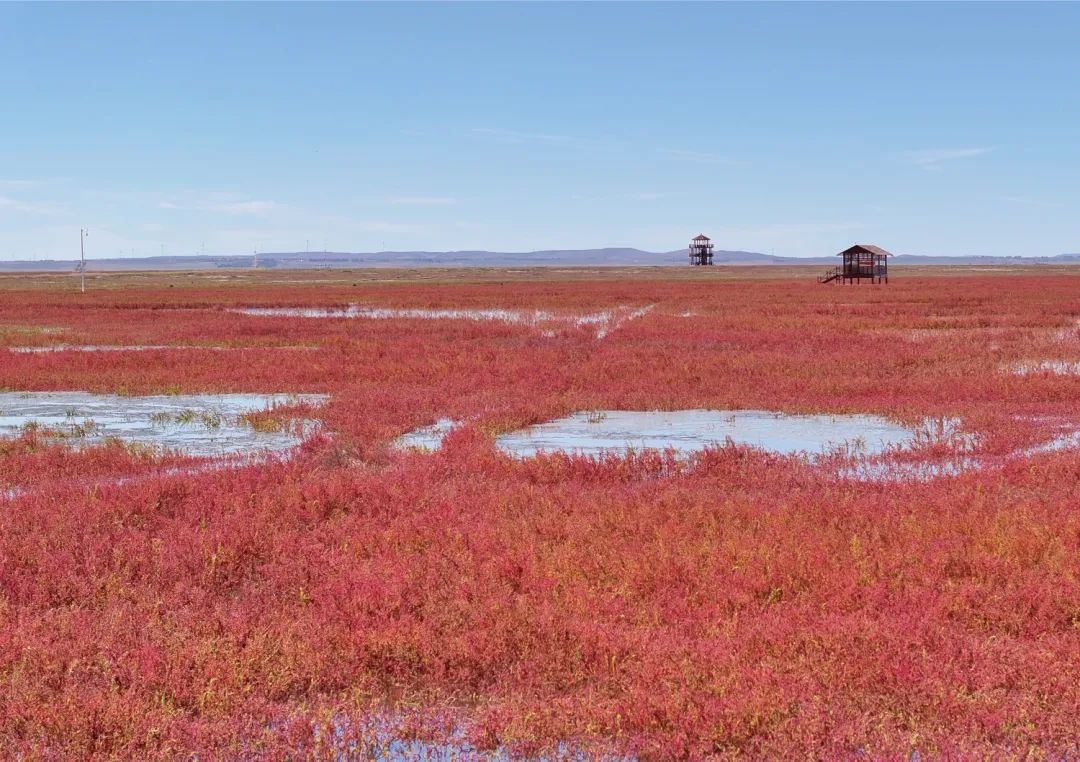
Chahannur National Wetland Park in Shangyi, Hebei Photo by Zhang Huixian
Hebei has actively promoted the deep integration of project construction and rural revitalization, driving the vigorous development of green industries such as forest tourism, forest wellness, and sightseeing and picking. Local people have truly enjoyed the fruitful results brought by good ecology and economic development, realizing the construction purpose of “blocking sand sources and protecting water sources for Beijing and Tianjin, and increasing resources and expanding wealth sources for Hebei.”
(Source: China Green Times)