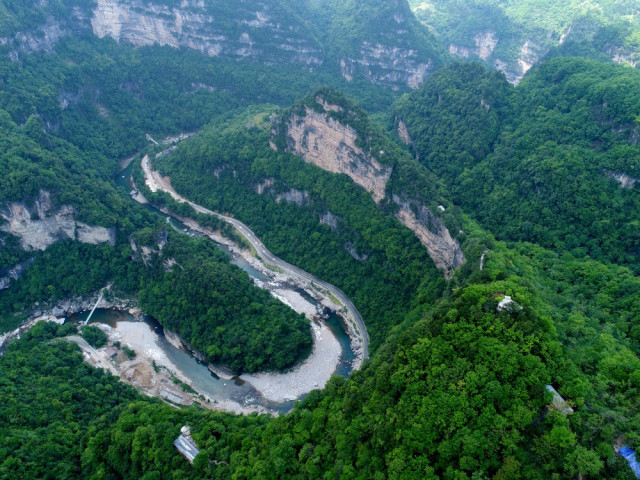
The Guangwushan-Nuoshuihe UNESCO Global Geopark located in the heart of the Micang Mountain serves as a transitional zone for geology geography climate and biology between North and South China. It spans Nanjiang and Tongjiang counties covering an area of 1818 square kilometres. The Geopark consists of Guangwushan Micangshan Shiba Yuetan Shenmen Nuoshui Dongtian Linjiang Lixia and Kongshan Tianpen. The Geopark boasts unique geological biological cultural and historical resources it is a typical area for comparative study of similar resources in the world.
The Geopark showcases a comprehensive geological profile sequence from the basement to the cover rock of the Yangtze Massif. This includes rocks strata and deformation structures spanning five geological historical periods: the Archean Eon Proterozoic Eon Palaeozoic Era Mesozoic Era and Cenozoic Era. It serves as an important platform and natural museum for studying the formation of ancient continents the coupling of intracontinental basins during the Mesozoic and Cenozoic Eras and the formation and evolution of the Qinling Orogenic Belt. A distinctive shield-shaped granite landform has been formed in the Geopark. The carbonate rock strata dating back to the Sinian Cambrian Ordovician Silurian Permian and Triassic periods have created unique and striking ridge-shaped peak clusters high-density karst cave groups and the fantastic and completely reserved calc-sinter landscapes. This establishes it as a classic and exemplary area for the study of karst and granite landforms in China. The Geopark features geomorphologic landscapes of water bodies characterised by Beach-Waterfall-Pond alongside geological tectonic landscapes typified by valleys all of which offer considerable aesthetic value. Furthermore the palaeontological fossils represented by Shuotherium dongi hold substantial scientific research value.
The Geopark boasts rich biodiversity featuring 2696 species of vascular plants 261 species of bryophytes 275 species of macrofungi 438 species of vertebrates and 188 species of insects. It is both the origin and modern distribution centre of Fagus plants creating a landscape of red foliage that spans nearly 680 square kilometres thereby earning the title "Hometown of Red Leaves in China." The Micang Ancient Path located within the Geopark is an integral part of the Shu Road serving as a crucial nexus linking Ba-Shu culture with Central Plains culture. It has been included on the World Natural and Cultural Heritage Tentative List and stands as a significant portal for global research on Chinese history and culture.