On April 15, at the 224th session of the UNESCO Executive Board held in Paris, France, Changshan in Zhejiang and Mount Siguniang in Sichuan successfully passed the review and were officially designated as UNESCO Global Geoparks. As a result, China now has 51 UNESCO Global Geoparks, distributed across 24 provinces, autonomous regions, municipalities, and the Hong Kong Special Administrative Region.
What geological scientific values enabled the two sites to be selected? What does the designation mean? What protection suggestions are there? Cover News spoke with He Qingcheng, Chief Scientist of the Chinese Academy of Geological Sciences and Executive Deputy Director of the National Geopark Network Center.
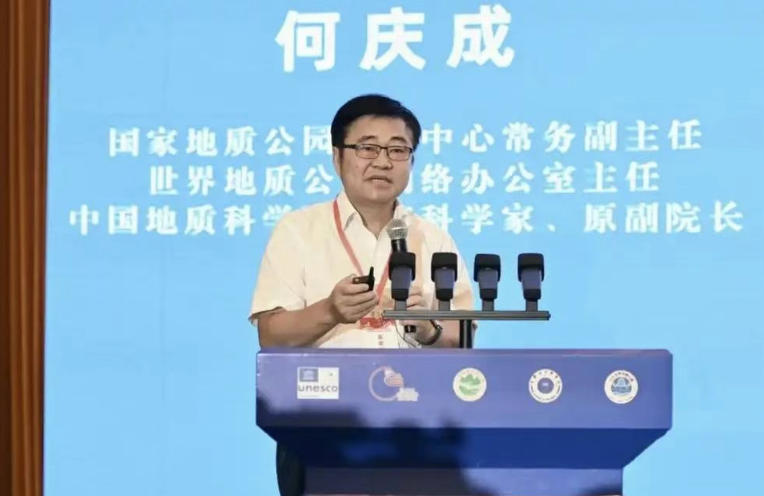
Cover News: In your opinion, what geological scientific values enabled Changshan in Zhejiang and Mount Siguniang in Sichuan to be successfully selected as UNESCO Global Geoparks?
He Qingcheng: These two geoparks each have their own distinctive features and represent two completely different types of geological evolution.
The core value of Changshan lies in the fact that it has China’s first Global Boundary Stratotype Section and Point, or GSSP, known as the “Golden Spike”: the Huangnitang Ordovician Darriwilian Stage section. It is the only global standard for correlating Middle Ordovician strata, giving it an irreplaceable position in international stratigraphy. Moreover, Changshan preserves a nearly one-billion-year continuous stratigraphic sequence from the Neoproterozoic to the Cenozoic, which is also the most complete in eastern Asia. Even more rare is the development of early Paleozoic reef-karst landforms there. These are in the juvenile stage and differ from mature karst, fully recording the entire process of reef formation, dissolution, and evolution. They have both scientific research value and landscape value, strengthening China’s voice in global Ordovician stratigraphy and paleobiological evolution.
Mount Siguniang presents a different picture. It is located in the core area of the Songpan–Ganzi orogenic belt on the eastern margin of the Qinghai-Tibet Plateau. It preserves the world’s largest Triassic “Xikang Group” turbidite flysch formation and typical Xikang-style folds. Mount Siguniang has the most representative cluster of extremely high mountains on the eastern margin of the Qinghai-Tibet Plateau, and it is also the easternmost distribution area of modern glaciers in China, making it a sensitive area and key site for global climate change research. In addition, with a vertical elevation difference of more than 3,700 meters, it forms a complete vertical zonation from arid valleys to forests, meadows, and glaciers. It also overlaps with the World Natural Heritage site of giant panda habitats, achieving a high degree of integration among geological relics, biodiversity, and cultural heritage.
What Does the Selection Mean?
Cover News: What does the selection of these two geoparks mean for geological scientific research and local sustainable development in China?
He Qingcheng: From the perspective of geological scientific research, the significance is very great. First, it enhances China’s global academic status. Both sites are geological relics of global correlation significance. Changshan consolidates China’s leading position in the global stratigraphic “Golden Spike” system, while Mount Siguniang has become an international frontier base for studying the uplift of the eastern Qinghai-Tibet Plateau, Tethyan evolution, and glacial climate. In the future, it is bound to attract top global teams to conduct joint scientific investigations and produce high-level research results.
The two sites complete the overall picture of China’s geological evolution. They connect two key geological units: the Paleozoic stable sedimentation of the South China Plate and the strong Cenozoic uplift of the Qinghai-Tibet Plateau, constructing a complete spatiotemporal framework from shallow-sea sedimentation to plateau orogeny. This provides key support for breakthroughs in major basic theories such as plate tectonics, paleoclimate, and biological evolution.
In addition, these two geoparks will promote interdisciplinary innovation, facilitating the integration of geology, paleontology, glaciology, ecology, remote sensing monitoring, and other fields. In the future, long-term field observation stations can be established to serve national needs in major geological safety, ecological protection, and climate change response.
From the perspective of local sustainable development, the empowering effect of a world-class brand is very obvious. UNESCO Global Geoparks become international ecological tourism brands that can drive new forms of business, such as high-end scientific expeditions, study tours, ecological vacations, and mountain sports. They promote local transformation from a resource-dependent economy to the conversion of ecological value, forming a positive cycle of “geological protection, science popularization education, and tourism-driven prosperity.” Specifically, Changshan can rely on its geological IP to strengthen specialty agriculture such as huyou pomelo and camellia oil and build geological study bases. Mount Siguniang can develop ecological tourism and Tibetan cultural tourism, driving employment for local residents and the development of homestays and cultural-creative industries, truly achieving a win-win outcome of protection and income growth.
What Impacts Will They Bring?
Cover News: What substantial positive impacts do you think the selection of these two geoparks will bring to local ecological protection and sustainable development?
He Qingcheng: This will strengthen the protection of geological relics and ecosystems. After being selected as UNESCO Global Geoparks, non-renewable geological heritage such as the Golden Spike section, folds, and glaciers will receive stronger protection. At the same time, the habitats of rare species such as giant pandas and snow leopards will also be maintained.
It will also compel the improvement and upgrading of the overall ecological environment. The two sites must implement measures such as water conservation, soil erosion control, vegetation restoration, and glacier monitoring. Changshan needs to improve the ecological quality of the Changshan Port basin, while Mount Siguniang needs to strengthen alpine ecology and glacier protection, reinforcing the ecological barrier in the upper reaches of the Yangtze River.
It will also greatly benefit the improvement of public scientific literacy and the formation of ecological consensus. Through the construction of geological museums, science popularization trails, and study-tour courses, the public can better understand the relationship between geological evolution and ecology, gradually forming a social consensus on protection first and green development, while reducing human-caused damage.
Infrastructure and public services will also be upgraded accordingly. Ecological trails, monitoring systems, and environmental protection facilities will be gradually improved, while tourism carrying capacity and service standards will be enhanced, ultimately achieving coordinated progress in ecological protection, tourism development, and people’s livelihood improvement.
What Risks Should Be Watched?
Cover News: Becoming a UNESCO Global Geopark is an honor, but also a responsibility. What protection risks do you think the two sites need to be most alert to at present? Could you offer some specific protection suggestions?
He Qingcheng: The main risks facing Changshan include possible human damage and illegal collection at the Golden Spike section and paleontological fossil sites; urbanization, agricultural development, and tourism construction may squeeze the space of core geological relics; and karst landforms and aquatic ecosystems may be threatened by pollution and overdevelopment.
For Mount Siguniang, the risks include the combined impacts of mountaineering, tourist trampling, waste pollution, and climate warming on high-altitude glaciers and fragile extremely high mountain ecosystems. Fold structures and flysch outcrops in the orogenic belt are vulnerable to damage from engineering construction and road excavation. A rapid increase in tourists may also overload ecological carrying capacity and lead to over-commercialization, affecting the local traditional ecological culture.
In response to these risks, I have several specific protection suggestions. First, strict graded and zoned control should be implemented to strengthen the bottom line of protection. First-level absolute protection zones should be designated to include the Golden Spike section, core folds, glacier sources, and other key areas. These zones should be fully closed for management, equipped with real-time monitoring, staffed by dedicated personnel, and strictly closed to all human activity. Second-level buffer zones should restrict tourism development and allow only scientific investigation and science popularization. Third-level coordination zones can be used for ecological tourism and community industries. At the same time, digital archives of geological relics should be established, with 3D scanning and regular monitoring of key sections, fossil sites, and glaciers, as well as a long-term change database.
Second, the intensity of tourism development should be strictly controlled, and scientific carrying-capacity management should be implemented. Both sites should adopt visitor reservation systems with total visitor limits and time-slot controls, while trails in core areas should be managed as closed routes. Mount Siguniang, in particular, should strictly control mountaineering routes and visitor numbers and prohibit unreported climbing activities. Changshan should restrict the construction of tourism facilities around core sections. At the same time, no-trace tourism and ecological study tours should be strongly promoted, with supporting facilities such as eco-friendly toilets and waste recycling facilities. Fossil collecting and rock-wall carving should be strictly prohibited.
Third, scientific research support and community co-governance should be strengthened. It is recommended to establish special research funds, jointly build field monitoring stations with universities and research institutes, and carry out studies on glacier retreat, stratigraphic protection, ecological restoration, and other topics to provide a scientific basis for protection. At the same time, community co-management mechanisms should be established to involve local residents in patrol, science popularization, and ecological services, allowing them to share tourism benefits and fostering a sense of ownership in “protecting geological heritage.”
In addition, regulations and international coordination mechanisms should be improved. Both sites should issue special local protection regulations, clearly define legal responsibilities for damaging geological relics, and strengthen law enforcement. They should also actively connect with the UNESCO Global Geoparks Network, participate in the formulation of global protection standards and experience exchanges, and accept international supervision and evaluation.
(Source: Cover News)